Sources: Netcraft, Verisign, W3Techs, Statista, DataReportal
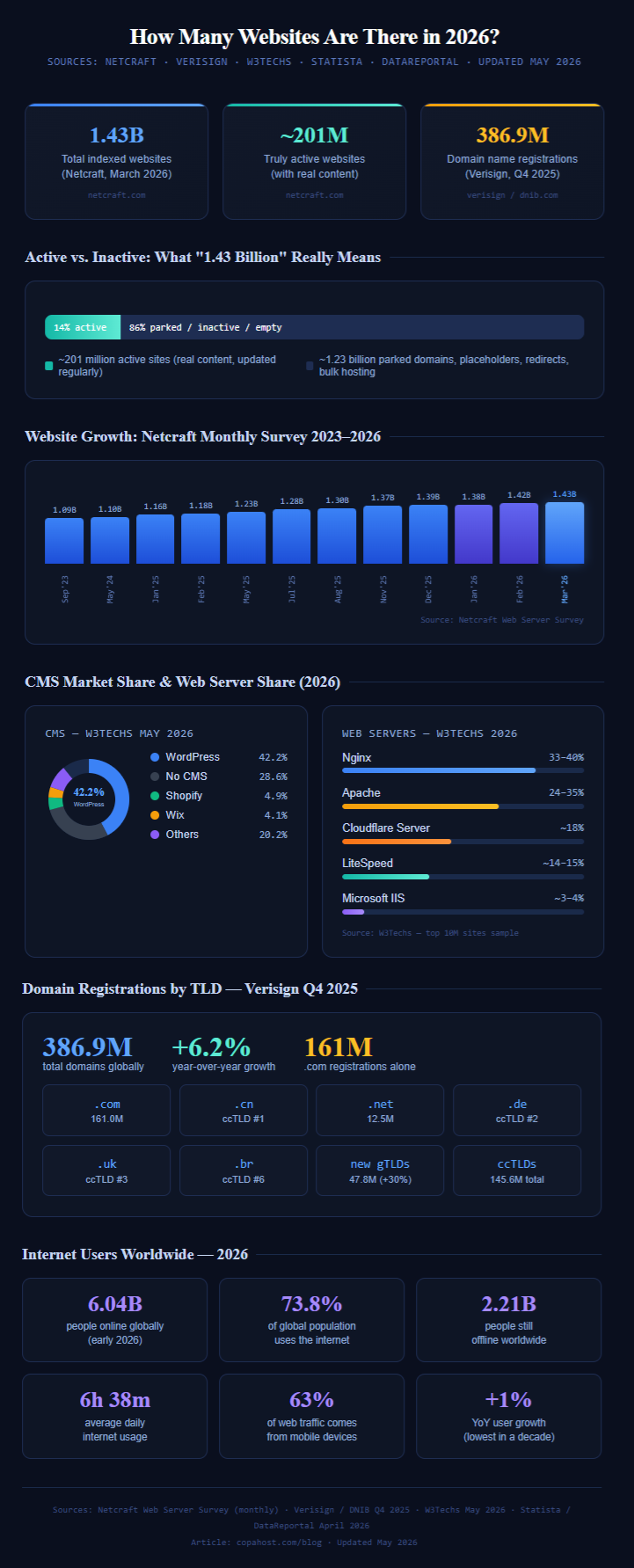
The short answer: approximately 1.43 billion websites exist on the internet as of March 2026 — but only around 201 million of them are actually active.
That gap between 1.43 billion and 201 million is the most important number in this article. Understanding it tells you more about how the web actually works than any single statistic.
The Two Numbers You Need to Know
Every article about “how many websites exist” runs into the same problem: the answer depends entirely on what you mean by “website.”
Total indexed sites: 1,427,812,919 as of March 2026 (Netcraft Web Server Survey). This counts every hostname that responded to a web server request — including parked domains, placeholder pages, redirect-only domains, and bulk hosting packages where customers registered domains but never built anything.
Active websites: approximately 201 million. These are sites with real, regularly updated content that serve unique pages to real visitors.
The difference — over 1.2 billion hostnames that exist but aren’t meaningfully “websites” — reflects how cheap domain registration has become and how many people register domains before they’re ready to build.
Table of Contents
Infographic
Netcraft Monthly Data: 2023–2026
Netcraft has been running its Web Server Survey since 1995, making it the most authoritative longitudinal dataset on web growth. Here is the complete recent history:
| Month | Total Sites | Domains | Web-Facing Computers |
|---|---|---|---|
| March 2026 | 1,427,812,919 | 297,642,950 | 14,225,050 |
| February 2026 | 1,419,977,535 | 297,071,903 | 14,379,914 |
| January 2026 | 1,376,952,390 | 295,088,466 | 14,365,221 |
| December 2025 | 1,389,596,802 | 291,965,818 | 13,972,590 |
| November 2025 | 1,366,582,597 | 288,926,456 | 14,008,584 |
| August 2025 | 1,300,016,299 | 281,522,947 | 13,797,308 |
| July 2025 | 1,275,138,490 | 280,876,958 | 13,740,462 |
| June 2025 | 1,247,534,188 | 279,324,818 | 13,556,908 |
| May 2025 | 1,227,232,638 | 277,546,948 | 13,470,692 |
| April 2025 | 1,218,287,328 | 277,498,967 | 13,441,067 |
| February 2025 | 1,180,650,484 | 274,656,941 | 13,480,350 |
| January 2025 | 1,161,445,625 | 273,352,681 | 13,423,989 |
| May 2024 | 1,097,398,145 | 268,137,699 | 12,898,459 |
| September 2023 | 1,085,035,470 | 254,776,456 | 12,274,854 |
Source: Netcraft Web Server Survey. Monthly data. April 2026 survey not yet published at time of writing.
Key observation: The total site count grew by approximately 342 million between May 2024 and March 2026 — an increase of 31% in under two years. Much of this growth is driven by Cloudflare and OpenResty, which host enormous numbers of hostnames relative to their web-facing computer count.
How Many New Websites Are Created Every Day?
Based on month-over-month changes in Netcraft’s data, an average of 37.5 million new sites are indexed per month — roughly 1.25 million per day.
That number includes everything from real new businesses to parked domains to auto-generated subdomains. Meaningfully new websites with unique content are created at a much lower rate, estimated at around 500,000–700,000 per day based on active site growth patterns.
Domain Name Registrations: 386.9 Million at End of 2025
While Netcraft counts hostnames, Verisign tracks domain registrations — a different but complementary measurement.
According to the Q4 2025 Domain Name Industry Brief:
- 386.9 million total domain name registrations across all TLDs at end of Q4 2025
- Growth of 22.7 million (+6.2%) year-over-year
- .com and .net combined: 173.5 million (161.0M .com + 12.5M .net)
- ccTLD registrations: 145.6 million — top 10: .cn, .de, .uk, .ru, .nl, .br, .fr, .au, .in, .eu
- New gTLDs: 47.8 million (+29.9% year-over-year — the fastest growing category)
Source: Verisign / DNIB.com Q4 2025 Domain Name Industry Brief, published February 5, 2026.
Why domain count and site count differ
Domain registrations (386.9M) are far fewer than Netcraft’s hostname count (1.43B) because a single domain can generate thousands of subdomains. A hosting provider with 100,000 customers might generate millions of hostnames in Netcraft’s count while representing only 100,000 domain registrations.
WordPress: 42.2% of All Websites
WordPress is so dominant that it deserves its own section.
According to W3Techs data for May 2026:
- 42.2% of all websites on the internet use WordPress
- 59.6% of all websites using a CMS run on WordPress
- WordPress has more than doubled its market share over the past decade, growing from 21% in 2014 to 42.2% in May 2026
CMS Market Share (May 2026)
| Platform | Share of All Websites | Share of CMS-Only Sites |
|---|---|---|
| WordPress | 42.2% | 59.6% |
| Shopify | ~4.9% | ~6.8% |
| Wix | ~4.1% | ~5.8% |
| Squarespace | ~2.4% | ~3.4% |
| Joomla | <1% | <2% |
| Drupal | <1% | <2% |
| No CMS | ~28.6% | — |
Source: W3Techs, May 2026.
Among the top 10,000 websites by traffic, WordPress accounts for roughly 58% of CMS usage — confirming that its dominance extends far beyond small sites into enterprise territory.
Every day, more than 1,000 new WordPress sites join the top 10 million websites tracked by W3Techs.
Web Server Market Share (2026)
Which server software actually runs the web? The answer has shifted significantly over the past decade.
By total hostnames (Netcraft, March 2026)
| Server | Market Share |
|---|---|
| Nginx | ~21–24% |
| Cloudflare Server | ~15.6% |
| Apache | ~12.0% |
| OpenResty | ~7.66% |
| LiteSpeed | ~5–6% |
| Microsoft IIS | ~1–2% |
By all websites (W3Techs, 2026)
W3Techs uses a different methodology — sampling the top 10 million websites rather than all indexed hostnames:
| Server | Market Share |
|---|---|
| Nginx | ~33–40% |
| Apache | ~24–35% |
| LiteSpeed | ~14–15% |
| Cloudflare Server | ~18% |
| Microsoft IIS | ~3–4% |
The discrepancy between Netcraft and W3Techs numbers is methodological: Netcraft counts all responding hostnames; W3Techs samples the top 10 million sites. LiteSpeed’s share looks larger in W3Techs because it over-indexes in the high-traffic, actively-managed hosting segment.
Notable trend: Apache’s share continues a long decline from its historic dominance (above 50% before 2012). Cloudflare Server — derived from nginx — has grown rapidly as more sites proxy through Cloudflare’s network. LiteSpeed is the fastest-growing server in the actively-managed hosting segment.
How Many Internet Users Are There in 2026?
Websites don’t exist in a vacuum — they’re built for users. Here is the current picture of internet users worldwide:
- 6.04 billion internet users globally as of early 2026
- 73.8% of the global population uses the internet (April 2026, Statista/DataReportal)
- 2.21 billion people remain offline — the largest concentrations in Southern Asia and Central Africa
- Growth rate: +1% year-over-year (April 2025–April 2026) — the slowest growth rate in the past decade, as the easily-reachable population is now largely connected
Internet Penetration by Region
| Region | Penetration Rate |
|---|---|
| Northern Europe | ~97.9% |
| Western Europe | ~93–95% |
| North America | ~93.1% (US) |
| East Asia | ~75% |
| Latin America | ~70–75% |
| Southeast Asia | ~65–70% |
| South Asia | ~60–65% |
| Sub-Saharan Africa | ~28–35% |
Sources: Statista, DataReportal, ITU — April/May 2026.
Mobile: 63% of global web traffic comes from mobile devices. In India, mobile traffic exceeds 70% of total web usage. Average daily internet usage worldwide: 6 hours and 38 minutes.
Total Websites vs. Active Websites: Why Most Sites Are Empty
This is the most frequently misunderstood aspect of web statistics.
The 1.43 billion hostname figure from Netcraft includes:
- Parked domains — registered but showing only a placeholder or for-sale page
- Expired sites — domains still resolving but with no updated content
- Bulk hosting packages — where a hosting provider registers thousands of domains on behalf of clients who never launch
- Auto-generated subdomains — a single hosting account can generate dozens of subdomains
- Redirect-only domains — pointing traffic to another URL without serving unique content
Approximately 201 million sites show signs of regular maintenance and unique content updates. That is 15% of the total. The other 85% exist in some form of dormancy.
This phenomenon is not new — the gap between registered domains and active sites has existed since the early 2000s — but it has grown as domain registration has become cheaper and more automated.
Historical Growth: From One Website to 1.4 Billion
The first website launched on August 6, 1991, at CERN — Tim Berners-Lee’s original page explaining the World Wide Web project, still accessible at info.cern.ch.
| Year | Approximate Total Sites |
|---|---|
| 1991 | 1 |
| 1993 | ~623 |
| 1995 | ~23,500 |
| 1998 | ~2.4 million |
| 2000 | ~17 million |
| 2005 | ~64 million |
| 2010 | ~207 million |
| 2015 | ~863 million |
| 2020 | ~1.74 billion* |
| 2023 | ~1.09 billion |
| 2024 | ~1.10 billion |
| 2025 | ~1.39 billion |
| 2026 (Mar) | ~1.43 billion |
Note: Netcraft recorded higher figures in 2020 that later decreased as spam and bot-generated sites were cleaned up. The methodology has been refined over time.
How These Numbers Are Measured: Methodology
Understanding the methodology prevents misuse of these statistics.
Netcraft Web Server Survey Netcraft sends HTTP requests to every known IP address and hostname on the internet, recording which respond with web server headers. Conducted monthly since 1995. Counts total responding hostnames — not unique websites in the human sense.
W3Techs Samples the top 10 million websites by traffic (Alexa/SimilarWeb-sourced). Reports technology usage (CMS, server, programming language) across that sample. Does not count all websites — only the observable, traffic-generating portion of the web.
Verisign / DNIB Counts domain name registrations through zone file data. Reflects how many domain names have been purchased, not how many have websites.
Internet Live Stats Estimates active websites using a combination of Netcraft data and modeling. The “live counter” on their homepage is an estimate, not a real-time measurement.
Each source measures something different. The correct answer to “how many websites are there” depends on which question you’re actually asking.
Key Takeaways
- 1.43 billion hostnames respond to web server requests (Netcraft, March 2026)
- ~201 million are truly active — regularly updated, serving unique content
- 386.9 million domains were registered worldwide at end of 2025 (Verisign)
- 42.2% of all websites run on WordPress (W3Techs, May 2026)
- 37.5 million new sites are created monthly on average
- 6.04 billion people use the internet — 73.8% of the global population
- Apache is in long-term decline; Cloudflare and LiteSpeed are growing
Sources
- Netcraft Web Server Survey (monthly): https://www.netcraft.com/blog/
- W3Techs CMS Market Share: https://w3techs.com/technologies/overview/content_management
- W3Techs Web Server Market Share: https://w3techs.com/technologies/overview/web_server
- Verisign Q4 2025 Domain Name Industry Brief: https://www.dnib.com/articles/the-domain-name-industry-brief-q4-2025
- Statista — Internet Penetration: https://www.statista.com/statistics/325706/global-internet-user-penetration/
- DataReportal Global Digital Overview 2026: https://datareportal.com/global-digital-overview
- Internet Live Stats: https://www.internetlivestats.com/total-number-of-websites/
This article is updated periodically as new Netcraft survey data becomes available.
Copahost provides web hosting and domain registration services. If you’re building a new website, explore our hosting plans.