
After nearly 23 years, PHP has finally done something it rarely does: changed its license. On May 7, 2026, the PHP Group officially retired the PHP License 3.01 and the Zend Engine License, replacing both with the widely trusted BSD 3-Clause license.
If you run a WordPress site, a Laravel application, a Joomla portal, or basically any PHP-powered project on shared hosting, VPS, or dedicated servers — this change affects the software that runs under your feet every single day.
Here’s what happened, why it took 23 years, and what it actually means for you as a website owner.
Table of Contents
What Changed, Exactly?
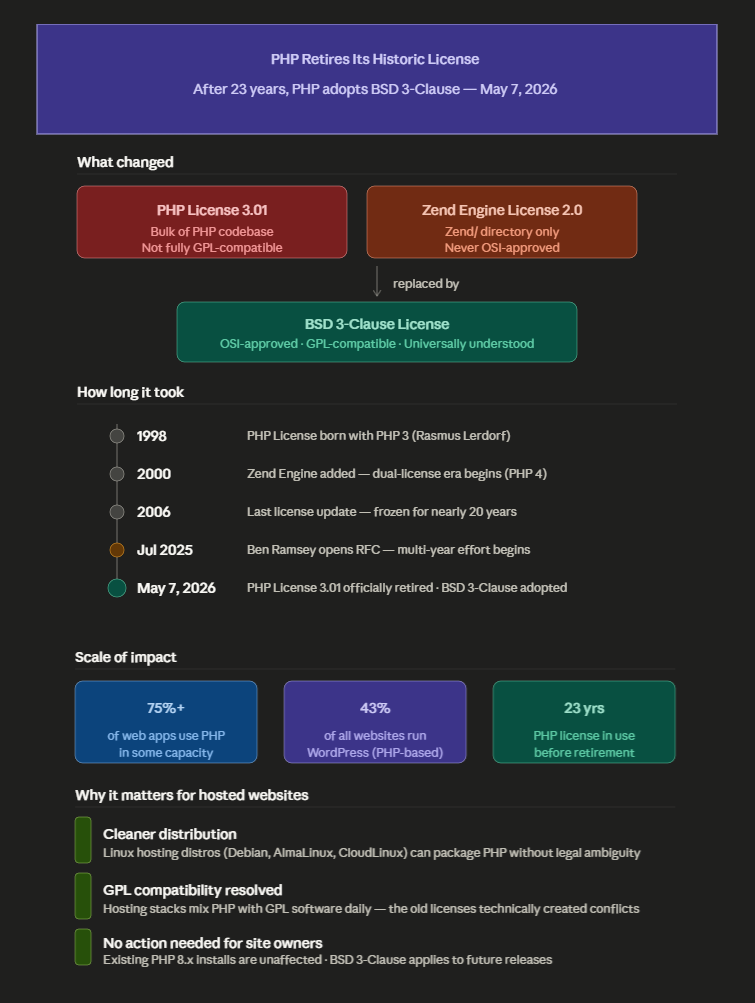
PHP has historically used two licenses simultaneously:
- PHP License v3.01 — covered the bulk of the PHP codebase
- Zend Engine License v2.0 — covered the Zend Engine, the PHP execution core
Both were custom licenses created by the PHP project itself. Neither was a bad license, but both came with quirks. The PHP License restricted use of the “PHP” name in derived products, creating real confusion for Linux distributions like Debian that patch and redistribute PHP. The Zend Engine License was never OSI-approved, and neither license was fully GPL-compatible — which created friction for anyone trying to package PHP alongside GPL software.
The fix? Replace both with BSD 3-Clause, one of the most permissive, battle-tested, and universally recognized open source licenses in existence.
Ben Ramsey, a PHP release manager who led this multi-year effort, summarized it well: strip away the PHP Group-specific and Zend-specific clauses from both licenses, and what remains is effectively BSD 3-Clause anyway. The change makes that implicit reality explicit.
The voluntary retirement of the PHP License 3.01 was formally submitted to the Open Source Initiative on May 7, 2026.
Why Did This Take 23 Years?
PHP’s licensing history is genuinely fascinating — and illustrative of how complex open source governance can get.
PHP has changed its license seven times between 1995 and 2006. It started under GPLv2, then adopted a custom Apache-inspired license with PHP 3 in 1998. PHP 4 brought in the Zend Engine, which came with its own separate license from Zend Technologies. By 2006, the dual-license structure was in place and effectively frozen.
For two decades, the licenses worked well enough that nobody wanted to go through the painful process of replacing them. Getting all the right people to agree — the PHP Group members, Zend (now owned by Perforce), and the broader internals community — required years of groundwork.
Ben Ramsey opened the RFC discussion in July 2025. By early 2026, every member of the PHP Group had approved the change, Perforce had signed off on the Zend relicensing, and the vote passed through the PHP internals community.
How Many Websites Run PHP Right Now?
This is where the scale of this change becomes clear.
PHP powers an extraordinary share of the modern web:
- WordPress uses PHP for the entire backend — and WordPress runs approximately 43% of all websites on the internet
- Joomla, Drupal, Magento, and PrestaShop are all PHP-based
- Laravel, Symfony, and CodeIgniter — the dominant PHP frameworks — are used by millions of custom web applications
- Every major shared hosting control panel (cPanel, Plesk, DirectAdmin) runs PHP handling as a core component
A reasonable estimate is that over 75% of all server-side web applications involve PHP in some capacity. This is not a niche change. It touches virtually every shared hosting server on the planet.
What Does This Mean for Hosting Providers?
For hosting providers, the BSD 3-Clause adoption removes several long-standing compliance headaches:
Cleaner distribution. Linux distributions that package and patch PHP — including the systems that run on hosting servers — no longer have to navigate the ambiguity of the “PHP Group” clause. The PHP Group has never been a clear legal entity, which created theoretical licensing uncertainty for redistributors. That uncertainty is now gone.
Better GPL compatibility. Hosting stacks frequently combine PHP with GPL-licensed software. The old PHP License and Zend License were not GPL-compatible, which technically created license conflicts in many production environments. BSD 3-Clause resolves this cleanly.
Simpler open source compliance. BSD 3-Clause is one of the most widely understood licenses in existence. Legal teams at every major company already know how to handle it. This reduces friction for enterprise customers evaluating hosting infrastructure.
What Does This Mean for Website Owners?
For most website owners, the honest answer is: nothing changes in the short term.
Your WordPress site will behave exactly the same tomorrow as it did yesterday. Your hosting plan, your plugins, your theme — none of that is affected by a licensing change to PHP itself.
What changes is the long-term health of the PHP ecosystem:
More contributions. Open source projects under restrictive or confusing licenses sometimes lose contributors who don’t want to deal with the legal ambiguity. BSD 3-Clause lowers that barrier, which can attract more developers to contribute to PHP core.
Better enterprise adoption. Some enterprise environments have internal policies that require software to use OSI-approved, GPL-compatible licenses before it can be deployed. The old Zend License blocked PHP from qualifying for those environments. That restriction no longer applies.
PHP’s longevity improves. Any change that reduces friction around PHP’s governance and distribution makes the language more sustainable. For a website owner whose entire business runs on PHP, that’s directly relevant.
When Does This Take Effect?
The PHP License 3.01 retirement was formally submitted to OSI on May 7, 2026. The transition applies beginning with the next major PHP release. Current production versions of PHP (8.x) are not affected retroactively — they remain under their original licenses. The new BSD 3-Clause license will apply to future releases going forward.
If you’re running PHP 8.1, 8.2, or 8.3 on your hosting account today, nothing changes for your existing installation. New PHP versions released under BSD 3-Clause will simply be cleaner from a licensing standpoint for everyone in the supply chain.
Should You Do Anything Right Now?
For the average website owner: no immediate action is required.
However, it’s always a good moment to make sure your hosting environment is running a currently supported PHP version. PHP version support windows matter — unsupported versions stop receiving security patches, which creates real risk for any production website.
As of May 2026:
- PHP 8.3 — Actively supported, security patches through late 2027
- PHP 8.2 — Actively supported, security patches through late 2026
- PHP 8.1 — Security-only support, reaching end-of-life November 2026
- PHP 8.0 and below — End-of-life, no longer receiving patches
If your site is running PHP 7.x or PHP 8.0, migrating to a current version is significantly more urgent than any licensing news.
The Bigger Picture
PHP’s license change is a small event in the day-to-day life of a website owner. But it reflects something important about the open source infrastructure the modern web depends on.
The software running your website isn’t static. It’s maintained by communities of developers who make governance decisions — about licenses, about security patches, about which features to build — that ripple outward to millions of production environments.
The BSD 3-Clause adoption is a sign that PHP’s stewards are actively managing the long-term health of a language that runs roughly 75% of the web. That’s worth paying attention to, even if you never need to think about license compatibility directly.
